



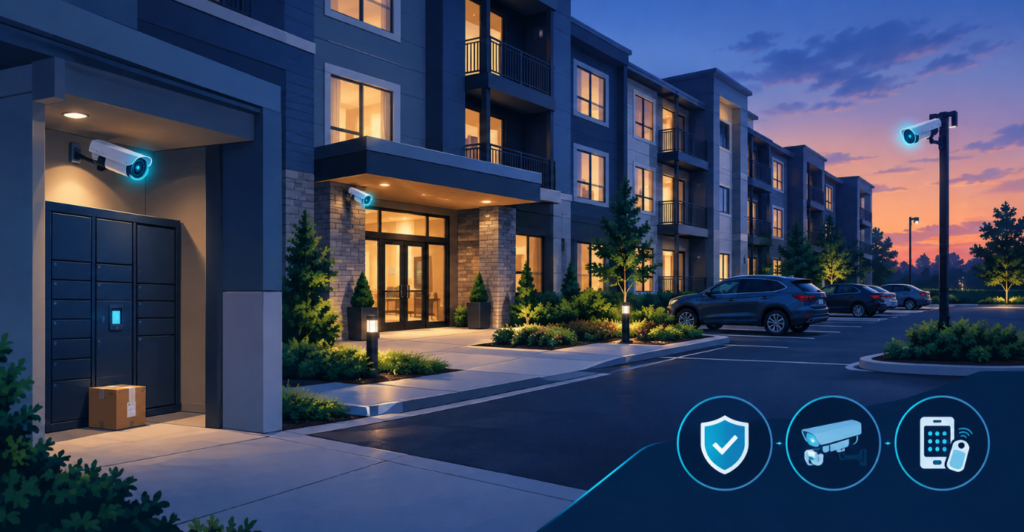
7 Apartment Complex Monitoring Benefits Property Managers Should Know
Property managers weighing whether to invest in monitoring often ask a simple question: does it actually work? Decades of crime prevention research give a clearer answer than vendor marketing usually does, and apartment complex monitoring consistently comes out as one of the more evidence-backed investments available.
This guide covers seven concrete benefits, grounded in research rather than assumptions, along with what property managers should know before choosing a system.
TL;DR
- A 40-year systematic review found CCTV surveillance meaningfully reduces crime in monitored areas.
- Live monitoring allows intervention during an incident, not just documentation afterward.
- AI-powered monitoring reduces false alerts, keeping staff responsive instead of desensitized.
- Access control systems address unauthorized entry more directly than cameras alone.
- Package theft prevention is one of the most immediate, visible benefits for tenants.
Does Apartment Complex Monitoring Actually Reduce Crime?
Direct answer: Yes. A large-scale systematic review with meta-analysis covering 40 years of CCTV research found that surveillance systems produce a measurable reduction in crime, particularly in settings like parking areas and property perimeters that closely resemble apartment complex environments.
The review, published through the U.S. Department of Justice’s research library, synthesized decades of independent studies rather than relying on a single dataset, giving property managers a stronger evidence base than typical vendor claims (OJP/NCJRS). This is the foundation the following benefits build on.
Benefit 1: Measurable Crime Reduction, Not Just Theory
Apartment complex crime statistics improve most consistently in properties that combine visible cameras with active management, according to systematic reviews on CCTV effectiveness. A Campbell Collaboration review of closed-circuit television surveillance and crime found consistent, though variable, reductions in crime across different property types when systems were properly implemented (Campbell Collaboration).
For property managers evaluating CCTV monitoring for apartments, this research matters because it shifts the conversation from “does this work” to “how do we implement it well,” which is where most of the real variation in outcomes actually happens.
Benefit 2: Live Video Monitoring Enables Real-Time Response
Live video monitoring apartments rely on creates a meaningfully different outcome than recorded-only footage. Recorded footage helps investigate what happened after an incident. Active monitoring allows staff or a remote team to respond while something is still unfolding — flagging suspicious activity, alerting authorities, or intervening before a situation escalates.
Properties using live video monitoring services rather than relying solely on stored footage shift from a reactive to a proactive security posture, which is where much of the measurable crime reduction in the research actually comes from.
Benefit 3: AI-Powered Monitoring Reduces Alert Fatigue
AI-powered apartment security addresses a problem that undermines many monitoring systems: too many irrelevant alerts leading staff to tune out notifications entirely, including the ones that matter. Systems that distinguish between people, vehicles, and background motion produce far fewer false positives than basic motion-triggered cameras.
Pairing this with how AI CCTV monitoring enhances security approaches keeps on-site and remote staff responsive rather than desensitized, which directly affects how quickly genuine incidents get addressed.
Benefit 4: Access Control Addresses Entry Points Directly
Apartment access control systems tackle a different vulnerability than cameras alone: unauthorized entry through shared doors, gates, or garages. Cameras document who entered; access control determines who’s allowed to in the first place, closing a gap that surveillance alone can’t fully address.
Properties combining access control with monitoring see fewer incidents tied to tailgating or shared key fobs than those relying on cameras as their only security layer. For multi-building complexes, remote access control also simplifies managing entry permissions across several entrances without requiring staff at each one.
Benefit 5: Package Theft Prevention
Apartment package theft prevention has become one of the most immediate, tenant-visible benefits of complex monitoring as delivery volume has grown across residential properties. Cameras covering package areas, combined with resident notifications when deliveries arrive, reduce the window of opportunity for theft significantly compared to unmonitored delivery zones.
This is also one of the easiest benefits for property managers to communicate to prospective tenants, since it addresses a concern renters experience directly and frequently, rather than an abstract security statistic.
Benefit 6: Remote Oversight for Multi-Property Portfolios
Remote video surveillance for property managers overseeing multiple complexes solves a coverage problem that on-site staff alone can’t: consistent monitoring across properties without needing dedicated personnel at every location. A centralized monitoring approach allows remote video surveillance to extend coverage to properties that would otherwise only have monitoring during business hours or staffed shifts.
This matters most for regional or national property management companies balancing security consistency against the cost of staffing every individual location around the clock.
Benefit 7: Reduced Liability and Stronger Tenant Retention
Best apartment security systems reduce a property manager’s liability exposure by demonstrating reasonable security measures were in place, which matters directly in the event of an incident and any resulting claims. Beyond liability, documented security investment is increasingly a factor tenants weigh when choosing where to renew a lease.
Properties that combine real time security monitoring with clear communication about safety measures tend to see this reflected in tenant satisfaction surveys and renewal rates, even when it’s difficult to isolate security as the single driving factor.
How Does Apartment Monitoring Work?
Direct answer: Apartment complex monitoring typically works by combining cameras at key locations — entrances, parking areas, package zones, and common spaces — with either on-site staff, a remote monitoring service, or AI-based analysis that reviews activity continuously and flags events that need attention.
Most modern systems layer several components: cameras with motion or AI detection, access control at entry points, and a monitoring service or app that receives alerts in real time. When something is flagged, staff can review footage immediately, contact authorities if needed, or address the situation directly, rather than discovering an issue only after reviewing recorded footage days later.
Choosing the Right System for Your Property
Property managers evaluating options should weigh a few factors before committing to a vendor or system:
- Whether the system offers active monitoring, AI-assisted alerts, or recording only
- Coverage of high-risk areas: entrances, parking, package zones, and stairwells
- Integration between access control and camera systems, rather than separate, disconnected tools
- Scalability if the portfolio includes or will include multiple properties
- Clear documentation practices to support liability protection
Getting this right from the start avoids the common trap of installing cameras without a plan for who reviews footage and how incidents get escalated — a gap that limits the real-world benefit of even well-installed systems.
Summary
Apartment complex monitoring is one of the more evidence-backed investments a property manager can make, supported by decades of independent research showing measurable crime reduction when systems are properly implemented. Live monitoring, AI-powered alerts, access control, package theft prevention, and remote oversight for multi-property portfolios each add distinct value beyond what cameras alone provide.
Property managers who treat monitoring as an integrated system — cameras, access control, and active review working together — rather than a collection of separate devices see the strongest results, both in measurable safety outcomes and in the liability protection and tenant confidence that come with a well-documented security program.
Frequently Asked Questions
Does apartment monitoring actually reduce crime, or is that just marketing?
Independent, peer-reviewed research — including a 40-year systematic review by the U.S. Department of Justice — has found measurable crime reduction associated with CCTV surveillance, particularly in areas like parking lots and property perimeters common to apartment complexes.
What’s the difference between recorded footage and live monitoring for apartments?
Recorded footage documents incidents after they happen, useful for investigations and liability protection. Live monitoring allows for real-time response while an incident is still occurring, which has a stronger effect on preventing escalation.
Do AI-powered systems really reduce false alarms?
Yes, in most cases. Systems that distinguish between people, vehicles, and background motion produce significantly fewer irrelevant alerts than basic motion-triggered cameras, helping staff stay responsive rather than tuning out notifications.
How does access control differ from camera monitoring?
Cameras document activity and can deter or help investigate incidents. Access control physically restricts who can enter a building or area, addressing unauthorized entry more directly than surveillance alone.
Can apartment monitoring reduce package theft?
Yes. Cameras covering package delivery areas, combined with resident delivery notifications, meaningfully reduce the window of opportunity for theft compared to unmonitored delivery zones.
Is remote monitoring worth it for multi-property management companies?
Often, yes. Remote monitoring extends consistent coverage across multiple properties without requiring dedicated on-site staff at every location around the clock, which is particularly valuable for regional or national portfolios.
Does better security monitoring actually affect tenant retention?
While hard to isolate as a single factor, properties that invest in visible, well-communicated security measures often see this reflected in tenant satisfaction and renewal decisions.
